Aaron Copland describes jazz not so much as a musical genre, but rather as a source of inspiration he drew upon while composing his works. Especially in the compositions he wrote during the 1920s and 1930s, the rhythmic color, syncopation, and timbral qualities of jazz are frequently heard. In his Concerto for Clarinet and String Orchestra, composed at the request of one of the most successful jazz clarinetists of his time, Benny Goodman, Copland makes extensive use of jazz’s harmonic richness, rhythmic vitality, and syncopated passages.
In this study, we will examine the lives of Aaron Copland and Benny Goodman, as well as the relationship between the Clarinet Concerto and jazz.
The Life of Copland
Born in Brooklyn in 1900 as the child of Russian-Jewish immigrant parents, Copland showed an interest in music at an early age. He learned to play the piano from his older sister, who was also his first teacher. By the age of fifteen, he had decided to pursue music and composition as a profession and began studying harmony. In 1921, he went to the American Conservatory founded at the Château of Fontainebleau in Paris. There, he had the opportunity to study with one of the legendary pedagogues in music history, Nadia Boulanger. Known for her extraordinary ear and high musical standards, Boulanger taught musicians such as George Gershwin and Philip Glass; however, Copland was the first American composer to study with her.
Instructional visits to the home of Nadia and Lili Boulanger were of great importance to young musicians of the period, though these visits often ended with harsh criticism. This approach, characteristic of the Boulanger sisters, reflected a pedagogical attitude based on high expectations and complete frankness. What Nadia especially demanded from her composition students was that they turn inward and toward their national cultures while developing an individual musical style. Copland deeply embraced this principle and reflected a distinctive and clearly American musical language in his works.
Three years later, Copland returned to the United States with a highly significant commission. Nadia Boulanger had asked him to compose an Organ Concerto. Considering the high esteem accorded to the organ in France, this assignment was a mark of great respect. In subsequent works such as Music for the Theatre (1925) and the Piano Concerto (1926), he made use of local musical sources.
Let’s listen to the Piano Concerto conducted by Leonard Bernstein, with Copland himself present.
In the works of this period, influences of Jewish folk dances and Hebrew melodies he heard during his childhood, as well as jazz and blues, began to emerge. At the same time, he was influenced by the music of Igor Stravinsky. The works through which he gradually distinguished himself as a young composer are known as the “Western Ballets”: Billy the Kid, Rodeo, and Appalachian Spring. Following his education in Paris, he also developed an interest in Schoenberg and the concept of atonality.
The Clarinet Concerto is one of the most important works of Copland’s mature period. Composed in 1947–48, this concerto is regarded as one of the finest examples of his conscious engagement with jazz. It was written on commission from the famous jazz clarinetist Benny Goodman, a fact that played a critical role in shaping the technical and aesthetic character of the work. Taking Goodman’s performing identity into account, Copland employed jazz-derived rhythmic figures, syncopated structures, and improvisation-like passages in the second movement.
The most striking musical feature of the work is that jazz is used not as improvisation, but as a written and formally controlled element. Thus, while preserving the classical concerto form, the piece simultaneously contains references to American popular music traditions through jazz melodies. This work demonstrates that Copland was able to express his American musical identity not only through folkloric or pastoral imagery, but also through a modern jazz aesthetic.
Copland also composed the music for two films (Of Mice and Men, 1938, and The Heiress, 1948). His work reflecting Schoenberg’s twelve-tone approach is Connotations, composed on commission in 1962. Copland stopped composing in 1970 and, until the mid-1980s, devoted himself exclusively to teaching and conducting. He passed away on December 2, 1990, in New York.

Aaron Copland (Photo: pages.stolaf.edu)
Conductor:Aaron Copland
Clarinet: Benny Goodman
Early Jazz, Benny Goodman, and the Clarinet
In the New Orleans jazz tradition, the clarinet was used as one of the leading melodic instruments alongside the trumpet and trombone. During this period, the clarinet’s primary function was to create delicate musical lines that ornamented the main melody and provided contrast within the improvisational texture. Owing to its timbre, which is close to the human voice, it also allowed for a quasi-vocal manner of performance.
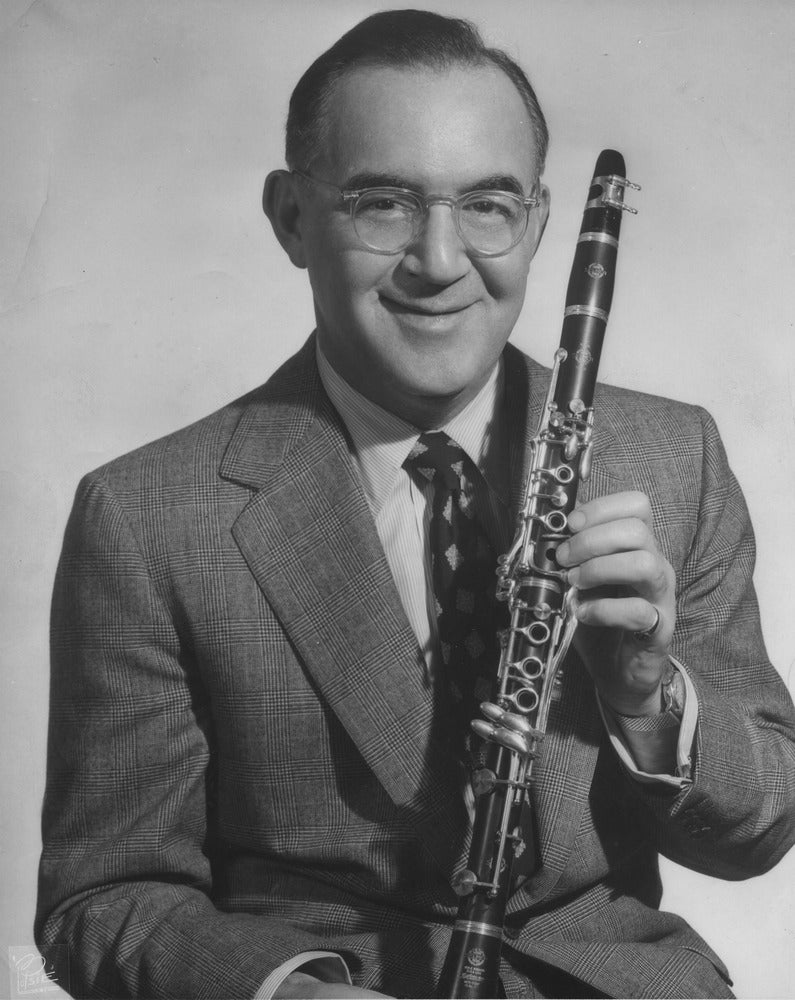
With the emergence of the swing era in the 1930s and 1940s, the clarinet became one of the most prominent solo instruments in jazz. During this process, Benny Goodman was among the most famous performers who turned the clarinet into a symbol of jazz.

Benny Goodman (Photo: www.selmer.fr)
Goodman’s high-level technique, articulation, and leadership in front of the orchestra enhanced the prestige of the clarinet in jazz music. He elevated the clarinet from a purely improvisation-based instrument to a stage instrument with high technical standards. In doing so, he established it as a bridge between jazz and classical music.
Conclusion
The works and recordings contributed to the musical literature by the legends of American music, Aaron Copland and Benny Goodman, clearly demonstrate how classical and jazz music can be blended and performed today. Through the innovative articulation techniques employed in the Clarinet Concerto, unique timbral colors are offered to music lovers. On behalf of all music enthusiasts, I would like to express gratitude to Aaron Copland and Benny Goodman for this remarkable concerto.
References
Copland, Aaron. 1952. Music and Imagination. Cambridge, MA: Harvard University Press.
Copland, Aaron. 1968. The New Music, 1900–1960. New York: W. W. Norton & Company.
Boulanger, Nadia. 1979. Nadia Boulanger on Education and Music. Edited by Leonie Rosenstiel. Washington, DC: Music Division, Library of Congress.
Url 1- https://www.loc.gov/collections/aaron-copland/about-this-collection/
Url 2- https://coplandfund.org/about
Url 3- https://www.fontainebleauschools.org/history
Url 4- https://www.britannica.com/biography/Aaron-Copland
Url 5 (fotoğraf 1) – https://www.selmer.fr/cdn/shop/articles/benny-goodman-nb-5dd538ec74004-5e0f3c2fee6f0.jpg?v=1678131208
Url 6 (fotoğraf 2) – https://pages.stolaf.edu/americanmusic/wp-content/uploads/sites/593/2019/10/Copland.jpg